When to Repair a Roof and When to Replace It
We read the roof first, then price the right fix in writing
(251) 850-0060
Open Monday to Sunday. Free, no-obligation estimates.
The 25 Percent Rule
Under the "25% rule", when more than a quarter of the roof surface is damaged, replacement is often recommended over another repair.
It is a rule of thumb, not a verdict. Once damage covers that much of the roof, it has stopped being a spot and become the roof's condition, and patching it piece by piece spends repair money on a roof that is wearing out anyway. Under that line, the answer turns on what the damage is and where it sits, which is what the signs below sort out.
We work that out on the roof, not from the driveway, and tell you which side of the line yours is on.
Signs a Roof Needs Replacing
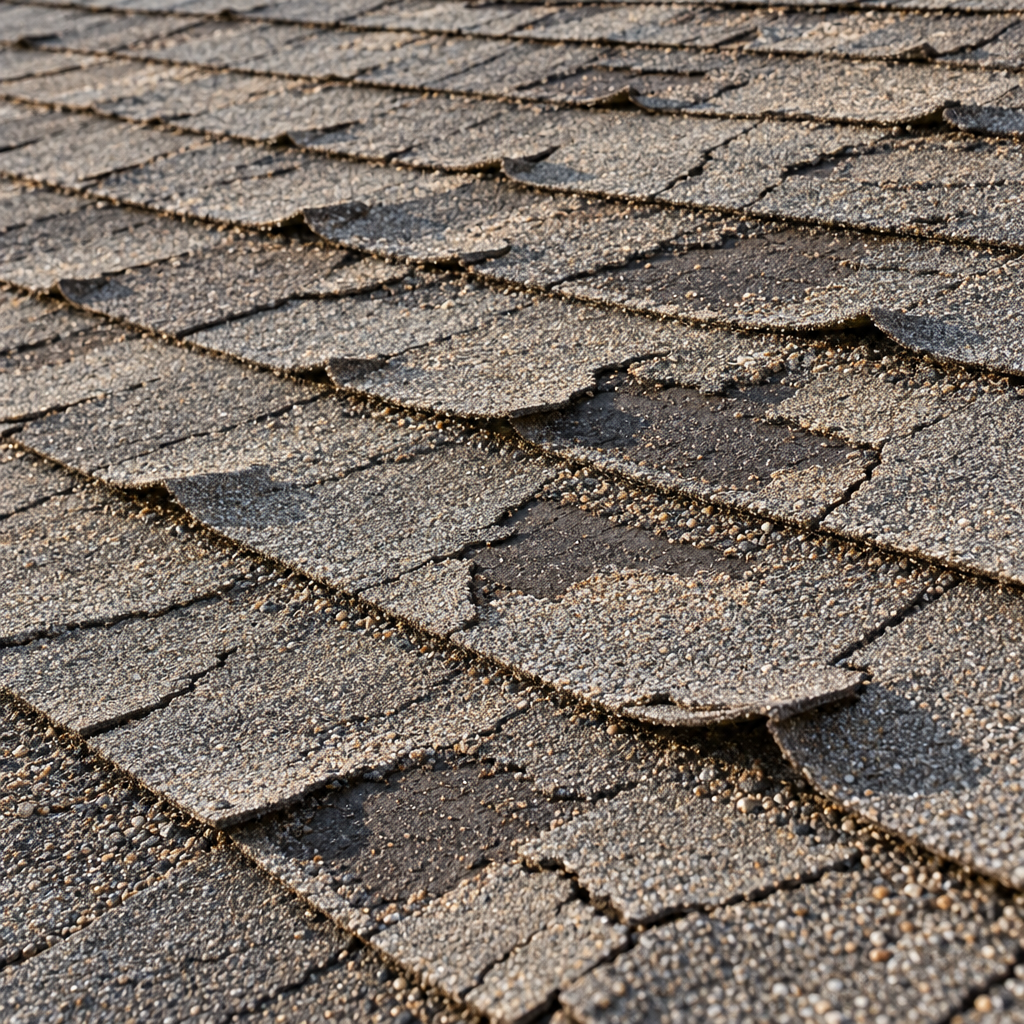
Recurring leaks, repeated patches, and shingles cracked, curling or shedding granules across the roof point toward replacement.
These are the signs that point to a new roof:
- Leaks keep coming back after they have been fixed.
- A slope has already been patched three times.
- The shingles are too brittle to lift without breaking.
- Shingles are curling or cracked across the roof, not in one corner.
- "Granule loss" shows everywhere: grit in the gutters and bald spots on the shingles.
When repairs stop lasting, each new patch buys less time, and repair stops being economical.
Signs a Repair Will Do
Damage confined to one area or one detail, on a roof under about 10 to 15 years old, may need only a repair.
These are the signs a repair will do:
- The damage sits in one area, such as a few displaced tabs.
- A single detail has failed: a split "pipe boot", a bad valley or open counterflashing.
- The roof is under 10 to 15 years old and sound everywhere else.
Repairs come in tiers. A broken seal or a few displaced tabs is a small course-level fix, while a failed boot, a bad valley or open counterflashing is a larger detail rebuild, and both are still repairs. The National Roofing Contractors Association (NRCA) roofing manual is the industry reference for how those details go together.
That is what the estimate is for
-
Free, no-obligation estimates.
We get on the roof, look at the damage and how far it runs, and the decision stays yours.
-
The whole job quoted before we start.
Repair or replacement, you see the scope and the price in writing, with no surprise charges after.
-
We show up when we say we will.
You get a time from us for the look at the roof, and that is when the ladder goes up.
-
We answer the phone or call back the same working day.
Calls outside our hours go to voicemail, and we return them the next working morning.
Age Alone Does Not Decide
A roof's age alone does not decide whether it needs replacement.
Age tells us what to look for, not what to do. A roof under about 10 to 15 years old is more likely to need only a repair, but an older roof with sound shingles and one split pipe boot still needs a boot, not a new roof.
It cuts the other way too. A younger roof whose slope has been patched three times, or whose shingles have gone too brittle to lift, has reached the point where repair stops paying. What decides it is what we find up there: how much is damaged, where, and whether the last repairs held.
Overlay Versus Tear-Off
An "overlay" saves the cost of tearing off the old roof, but it weakens the fastening and hides any rot, while a full "tear-off" outlasts it.
-
The one that lasts
Full tear-off
- Old roofing stripped down to the deck
- Hidden deck damage found and repaired
- Nails driven into sound wood
- Outlasts a roof laid over the old one
-
A second layer
Overlay
- Saves on tear-off and disposal
- Nails through two layers hold less well
- Any rot in the deck stays hidden
- Adds weight and can shorten roof life
What Comes Next
Either way, the path ends with a roofer's scope of work and a written estimate, so you see what is being done and what it costs before anything starts.
The repair path
A repair
We find the failed area or detail and the estimate names it: a course-level fix for a broken seal or a few displaced tabs, or a detail rebuild for a pipe boot, a valley or the "counterflashing", the cap flashing over the step flashing at a wall or chimney.
Each part the estimate names is a part we fix with materials that match the roof you already have, so the repair belongs to the roof.
The replacement path
The Replacement Job
A replacement tears the old roofing off down to the deck, repairs the deck and puts a complete new roof system on top.
Hidden decking damage is checked and repaired before any new roofing goes on, so nothing new is nailed into rot.
Repair or replace? Call and we'll look
We get on the roof, tell you which one it needs and why, and put the whole job in writing before any work starts.
Monday to Sunday, morning to evening. Calls outside those hours go to voicemail and we return them the next working morning.
Free, no-obligation estimates. The scope and the price in writing, no surprise charges after, and we clean up when the work is done.